When street support ends, Auckland’s safety net thins out
• April 8, 2026
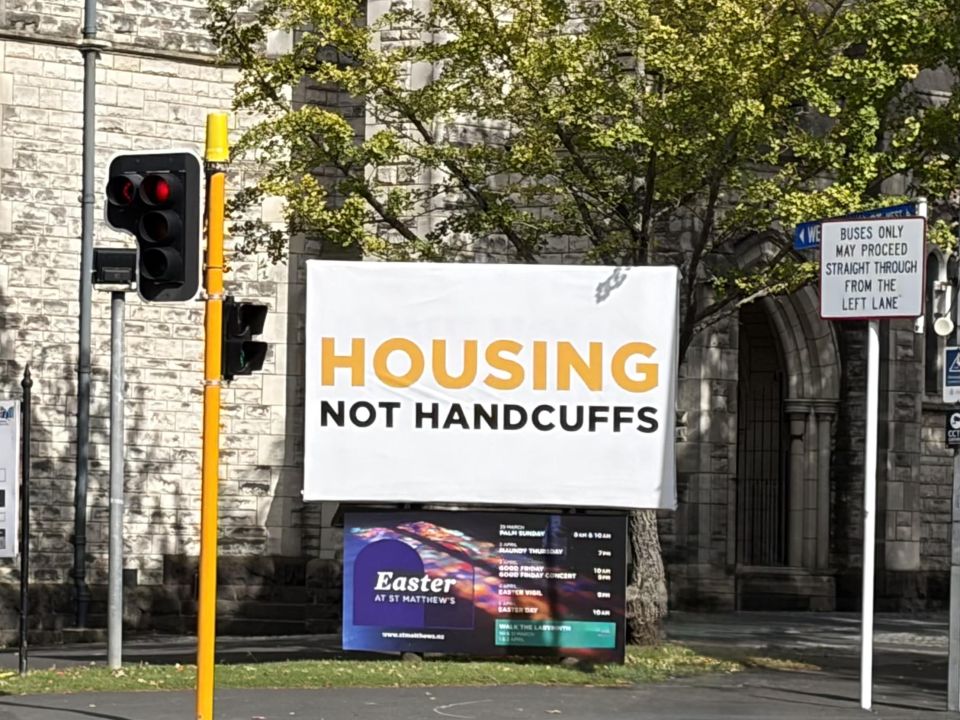
‘Housing Not Handcuffs’ campaign banner in Auckland urges help for the city’s most vulnerable Photo: Maxine Seto Ma
When Auckland City Mission’s street outreach service finishes at 9pm, some people in the city centre are left without any clear support overnight.
The mission's street-to-home manager, Samara Tohilima, says her team does its best to make sure everyone has somewhere to go before finishing their shift.
“It’s not always possible. Sometimes people fall through the cracks once we’re off duty," she says.
The street outreach service ensures people in need get food, housing and health support.
It follows up on referrals from the council, police, libraries and members of the public, aiming to respond within one to two days, says Tohilima.
Currently, the street service operates from 6am to 9pm.
Tohilima says it’s usually police who must respond after hours.
“We want to be out there 24/7, but we don’t really have the resources.”
She says the team often flags concerns to police and council staff before signing off for the night, especially when something appears risky in the city centre.
“Because we’re in really good comms, and collaborate with the police and with the council, usually we will let them know what’s happening.”
While emergency services remain available overnight, police say their role is limited when a situation does not involve an immediate threat to safety or involve offending.
If there is an immediate risk to someone’s safety or offending is occurring, the police urge people to call 111.
Tohilima says delayed help can have serious consequences, especially for people dealing with untreated health conditions of mental distress.
She recalls one case involving a man whose untreated infection later became life-threatening.
“Because if he had just stayed out there, with no medicine, no treatment, he would have died,” she says.
Auckland City Mission data shows the outreach team recorded 262 outreach notification responses and 1218 direct engagements from 2024 to 2025.
The same data shows 510 clients were supported by housing services.
City Centre Residents’ Group spokesperson Antony Philips says many residents feel safe living in the city centre.
One resident he spoke to says they felt much safer in the city than the suburbs because there are more people around.
But Philips says support is not always sufficient for people living on the fringes of society.
“The answer is, do we have enough for those people? Probably not."
Phillips says one of the clearest issues is funding.
“If we were able to give more money to the Auckland City Mission, they would be able to complete a lot of those outreach services.
“Mental health, particularly social services support, funding has declined over the years."
Presbyterian Support Northern (PSN) says funding cuts have forced its Lifeline Aotearoa helpline to reduce hours since March 1 last year, leading to missed calls and limiting 24/7 service.
“Probably the biggest improvement that we could do is if we were to gain more resource and more funding to be able to help people faster,” Tohilima says.
Lifewise and Kickback are other street outreach services that provide assistance to those in need.
TWN's 2026 campaign looks at just what is going on in the Auckland CBD.
-----
Our journalists sometimes use AI tools which are checked by humans for accuracy.
AI was used to transcribe audio from the interview.

Entrepreneurial platform for migrant women hopes to help change negative narratives
Keesha Levesque • June 8, 2026
Entrepreneurial platform for migrant women hopes to help change negative narratives
Keesha Levesque • June 8, 2026