On the fence: Student fencers faced with financial pressures
• March 25, 2026
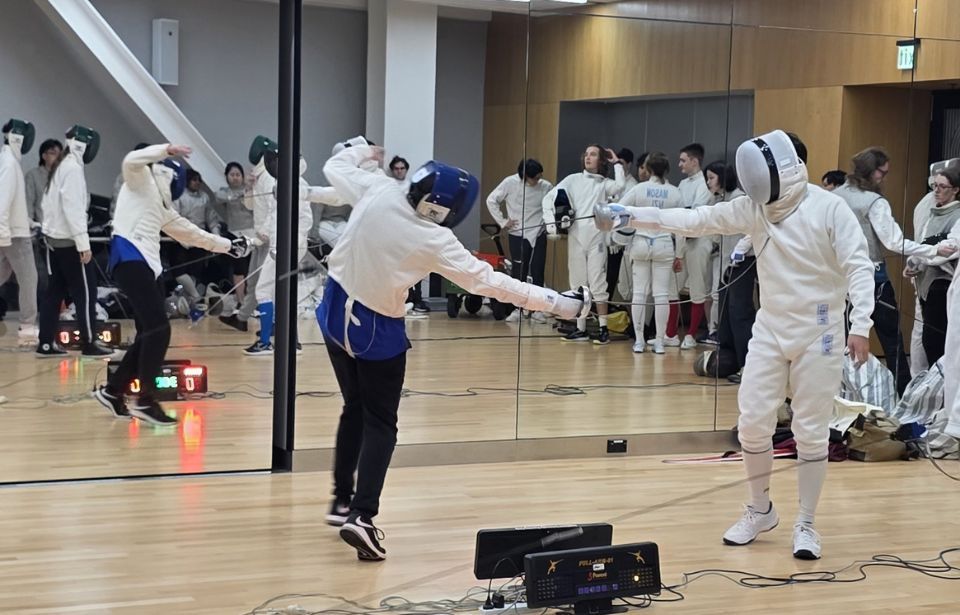
Students meet bi-weekly at the Auckland University fencing club. Photo: Daniella King
Student fencers are facing financial pressures, with many forced to consider quitting the sport.
With no financial support from the government, fencing is becoming an increasingly expensive sport to compete in, particularly for students.
As a self-funded sport, students must cover the cost of travel, accommodation, gear, competition fees, healthy diets, gym memberships and private coaching.
It adds up quickly, often reaching costs in the tens of thousands of dollars.
Competitive fencer for almost 10 years Elsie Lins recently placed third in the under-20 Australian nationals, and was selected to compete in the FISU World University Games.
Since returning from her exchange in Germany, Lins has noticed rising costs.
“The cost really puts a lot of strain on a person, and it takes a lot of energy to compete...it's quite difficult,” she says.
Global issues like the Ukrainian war have also contributed to financial pressures, with metal manufacturing and shipping costs causing gear prices to increase.
Fencer Emi Mason has been in the sport for five years, and up until recently, she was number one for the women’s under-20s division in New Zealand.
Although she lives at home with her parents, Mason has seen the impacts that financial pressures are having on fellow student fencers.
“A lot of people have dropped off fencing because of financial stress.
“There's so much talent in New Zealand that just doesn't have that opportunity to travel overseas,” she says.
Longtime fencer, coach, student and general executive of the Auckland University fencing club, Matthew Valkenburg, says it is particularly expensive for New Zealand fencers to travel due to being so geographically isolated.
He juggles several roles to support himself and his students.
“[Experienced coaches in Auckland] are quite hard to come by. And then when I do put in the work to develop that skill myself, [I] can get spread quite thin,” he says.
Student fencers are seeking government funding, but the sport needs to show promising results first, “it’s a chicken and an egg problem,” according to Valkenburg.
New Zealanders fencers struggle to succeed internationally, with overseas players being more financially supported by their organisations.
“Obviously, they're going to have so much more skill, so much more bandwidth to even have the energy to compete at that level...and we don’t have that here,” Lins says.
-----
Our journalists sometimes use AI tools which are checked by humans for accuracy.
AI was used for this story to transcribe audio from interviews.



Entrepreneurial platform for migrant women hopes to help change negative narratives
Keesha Levesque • June 8, 2026
Entrepreneurial platform for migrant women hopes to help change negative narratives
Keesha Levesque • June 8, 2026