Auckland health programme treats both STIs and stigma
• April 1, 2026
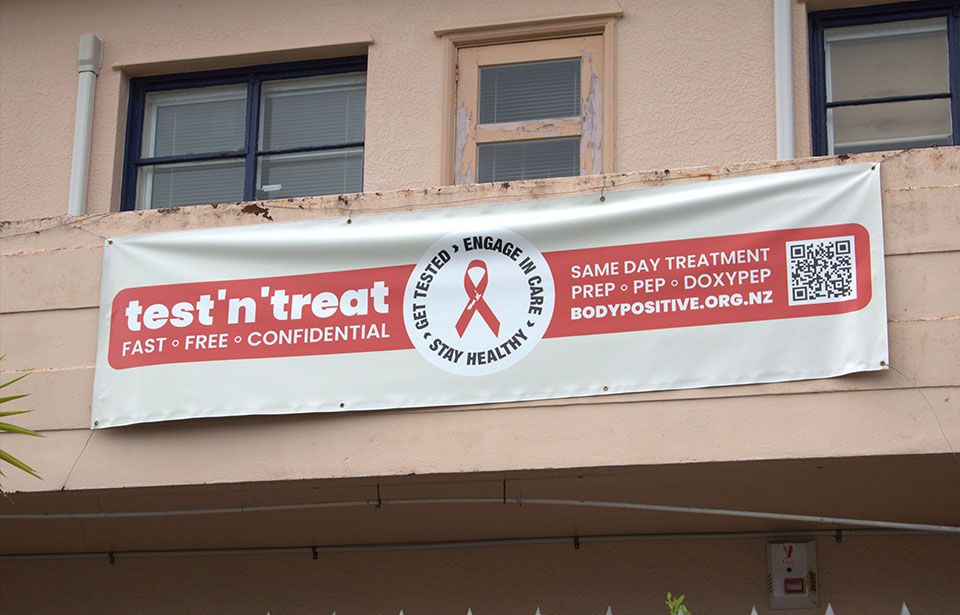
Body Positive Inc. hosts the Test’n’Treat program, which is open for drop-in appointments Monday to Friday. Photo: Keesha Levesque
Demand for a new sexually transmitted disease programme in Auckland has doubled in the past few months.
Body Positive Inc., in partnership with Auckland Sexual Health, launched the peer-led Test’n’Treat programme in December to provide fast, stigma-free STI testing.
Body Positive was established in the 1980s as a non-profit to support people living with human immunodeficiency virus (HIV).
Executive director at Body Positive Mark Fisher says there has been a rise in demand for Test’n’Treat appointments.
“Rather [than] doing siloed approaches to sexual health . . . we are trying to do a more comprehensive solution where sexual health is for everybody and it includes everything,” he says.
Test’n’Treat is almost entirely peer-led, except for an on-site nurse who administers treatments and vaccinations within 24 hours of testing.
Clinical nurse lead for Sexual Health Auckland Claire Caiger says peer-led testing reduces stigma by removing traditional healthcare hierarchies.
“We’ve got like a community [education] team that go out into schools and universities, and they’re all young, a lot of them are queer, and it really reduces the barriers.
“I think just talking to people you see likeness in yourself”.
While rates for syphilis, gonorrhea and chlamydia have dropped slightly in 2025, there are still hundreds of reported cases each year.
Caiger says barriers such as access to care, lack of testing, and cultural reasons can be contributing factors to these outbreaks.
“I know that in more rural centres, the clinicians are not comfortable speaking to patients about it,”.
She says STI testing should become a routine like other regular health checks.
Sexual Wellbeing Aotearoa director of nursing Julie Avery says sexual health and STI testing should be normalised and demedicalised.
“Educate everybody from a young age about safe sex, a healthy sex life and treating your body like you would anything else,” she says.
Under this model patients do not have to disclose what they would like to be tested for.
Instead, they receive a single blood draw with an option for a finger prick that tests HIV, hepatitis C, syphilis, gonorrhea, and chlamydia.
Results are available within 90 minutes.
A 2023 Sexual Wellbeing Aotearoa survey found 63 per cent of respondents said practitioners only discussed STIs if they raised it or had symptoms.
Half of the respondents’ main source of information on STI's was found through websites.
“Getting an STI is kind of seen as a bad thing when in reality, it’s just a fact of life that you’re probably going to get one,” says Fisher.
Fisher says people may avoid STI testing due to feeling intimidated, judged, or questioned.
“Twenty-eight per cent of the people [being tested] had never had sexual health testing before. They don’t feel comfortable with it,” he says.
Body Positive includes a survey for patients with the Test’n’Treat programme that asks about their experience with the model.
“People just find it really comfortable and not stigmatising at all,” says Fisher.
The non-profit is aiming to release the survey data this September.
-----
Our journalists sometimes use AI tools which are checked by humans for accuracy.
AI was used to transcribe audio from the interview.

Take 10: A safe space for youngsters spending the night in Auckland city centre
Kyla Blennerhassett • June 4, 2026


Take 10: A safe space for youngsters spending the night in Auckland city centre
Kyla Blennerhassett • June 4, 2026
Parents struggle to top up kids' bus cards, call for free transport for all students
Daniella King • June 3, 2026